
Table of Contents
It’s Friday evening. A customer lands on your Shopify store looking for “winter clothes” to prepare for the cold months ahead. They search your site, excited to browse your collection. But the search bar returns nothing—or worse, a handful of completely irrelevant products.
Why? Because your products are labeled “parkas,” “thermal jackets,” and “wool sweaters,” not “winter clothes.” Your search function is looking for exact keyword matches, blind to the meaning behind the customer’s words. They leave frustrated. Your competitor who understands semantic search captures the sale instead.
This scenario plays out thousands of times across Shopify stores every single day. But it doesn’t have to be this way. Let’s explore why traditional search fails your customers—and how semantic search can transform your store’s discoverability, conversion rates, and revenue.
The Problem with Keyword Search
Traditional Shopify search operates like a very literal librarian. Ask for “winter clothes” and it searches your product database for those exact words. No match? No results. It doesn’t understand that a “parka” is a type of winter clothing, or that “thermal base layer” serves the same purpose.
This limitation creates three critical problems:
- Synonyms go undetected. Your customers think in different language than your product titles. Someone searching “athletic shoes” might find no results even though you sell “running sneakers” and “trainers.” The algorithms miss these natural variations in how people describe the same thing.
- Customer intent remains hidden. When someone searches “cozy blanket for cold nights,” they’re expressing an intent—comfort and warmth—that goes beyond those specific words. Traditional search can’t decode this intention. It’s looking for the phrase “cozy blanket,” not understanding that a “fleece throw” or “thermal comforter” fulfills the same need.
- Natural language gets ignored. Real people don’t search like product databases. They use conversational language, phrases, and descriptions. Your search function treats every query as a string to match against a catalog, missing the nuance and context that humans naturally understand.
The result? Higher bounce rates, abandoned searches, lost sales, and frustrated customers who can’t find what they want—even when you have it in stock.
The Solution: What is Semantic Search?
Imagine replacing that literal librarian with an expert curator who understands not just the words you use, but what you mean. That’s semantic search.
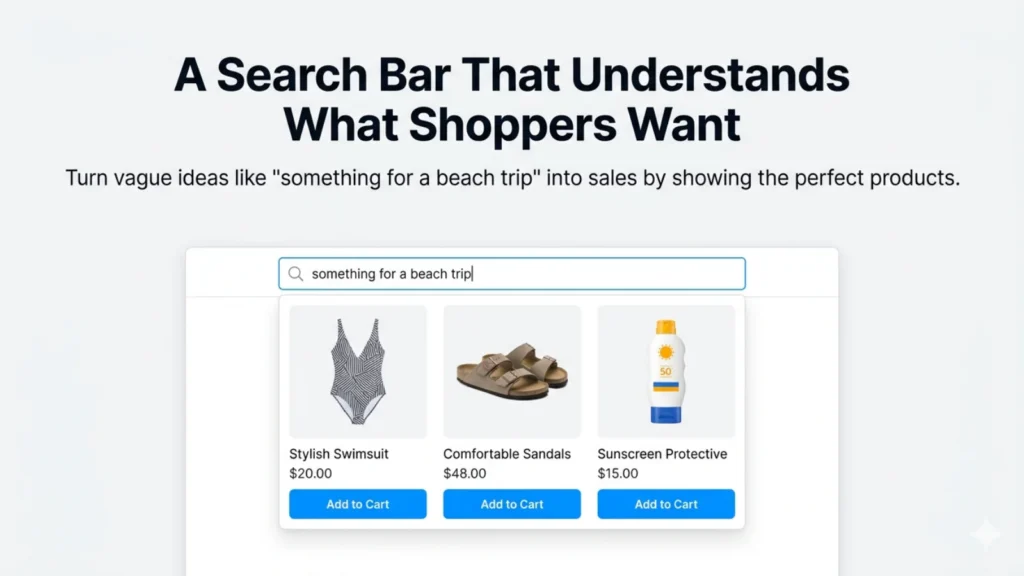
Semantic search technology analyzes the meaning behind both customer queries and your product descriptions. Instead of looking for keyword matches, it understands the relationship between concepts. When a customer searches for “cozy winter wear,” the system grasps that they’re looking for comfort, warmth, and seasonal relevance—and returns parkas, sweaters, thermal jackets, and blankets that match that intention.
Here’s how it works: Advanced language models convert search queries and product data into “semantic vectors”—mathematical representations of meaning. Products and searches with similar meanings cluster together in this space. When a customer searches “athletic footwear,” the system understands this is semantically similar to “running shoes,” “sneakers,” and “trainers,” even though the words don’t match exactly.
The beauty is that semantic search works with your existing product data. It doesn’t require extensive tagging or manual categorization. It learns the meaning of your products from their descriptions, titles, and attributes—the information you already have.
How Semantic Search Boosts Revenue
The impact of implementing semantic search goes far beyond finding the right product. It directly drives three measurable revenue improvements:
- Dramatically fewer failed searches. When customers can’t find what they’re looking for, they leave. Studies show that 20-30% of Shopify stores suffer from “search abandonment”—customers give up and exit. Semantic search reduces failed searches by 50-70%, keeping customers engaged and browsing longer. They find products they didn’t even know you had.
- Higher conversion rates from search. Customers who find relevant products through search are significantly more likely to purchase than those who browse categories. When your search actually understands what customers want, conversion rates from search traffic improve by 25-40%. A customer who finds exactly what they were looking for is a customer ready to buy.
- Increased average order value (AOV). Semantic search doesn’t just help customers find their primary intent—it surfaces complementary products. Someone searching for “winter jacket” might also see “thermal gloves” and “wool scarves” as related products. Cross-selling through semantic discovery increases AOV by 15-20% without aggressive upselling tactics. It feels natural because the recommendations are genuinely relevant.
These aren’t theoretical gains. Shopify stores implementing semantic search report measurable improvements in search-to-conversion metrics within weeks of deployment.
Adding Semantic Search to Your Store
Here’s the good news: implementing semantic search no longer requires months of development work or rebuilding your search infrastructure.
SmartAgent brings semantic search to your Shopify store as a simple, plug-and-play solution. It installs in minutes—no complex setup, no custom coding required. Once activated, SmartAgent analyzes your product catalog and automatically starts understanding customer search intent through semantic matching.
Unlike other search solutions that require extensive configuration, SmartAgent works instantly with your existing product data. Your customers get smarter search results immediately, and you get deeper insights into what customers are actually looking for.
The setup is straightforward:
- Install the SmartAgent app from the Shopify App Store
- Connect it to your store in under 2 minutes
- Semantic search goes live immediately
- Watch your search metrics and conversion rates improve in real time
No technical expertise required. No database migrations. No downtime. Just better search that actually understands your customers.
Conclusion: Stop Losing Sales to a Broken Search
The difference between “winter clothes” and “parkas” might seem small, but it’s the difference between a sale and a lost customer. Traditional keyword search is letting you lose money every single day—through abandoned searches, frustrated customers, and missed cross-sell opportunities.
Semantic search fixes this fundamental problem. It understands what customers want, not just what words they use. It’s the natural evolution of how search should work, and it’s no longer a luxury feature—it’s table stakes for competitive Shopify stores.
If you’re losing sales because your search can’t understand customer intent, the fix is simpler than you think. SmartAgent brings semantic search to your store in minutes, not months.
Ready to transform your Shopify search?
Start for free trial today and see how much revenue you’ve been leaving on the table.
Because your products deserve to be found. And your customers deserve search that actually understands them.